8718 WESTPARK DR, HOUSTON, TX 77063 | 713-589-2925
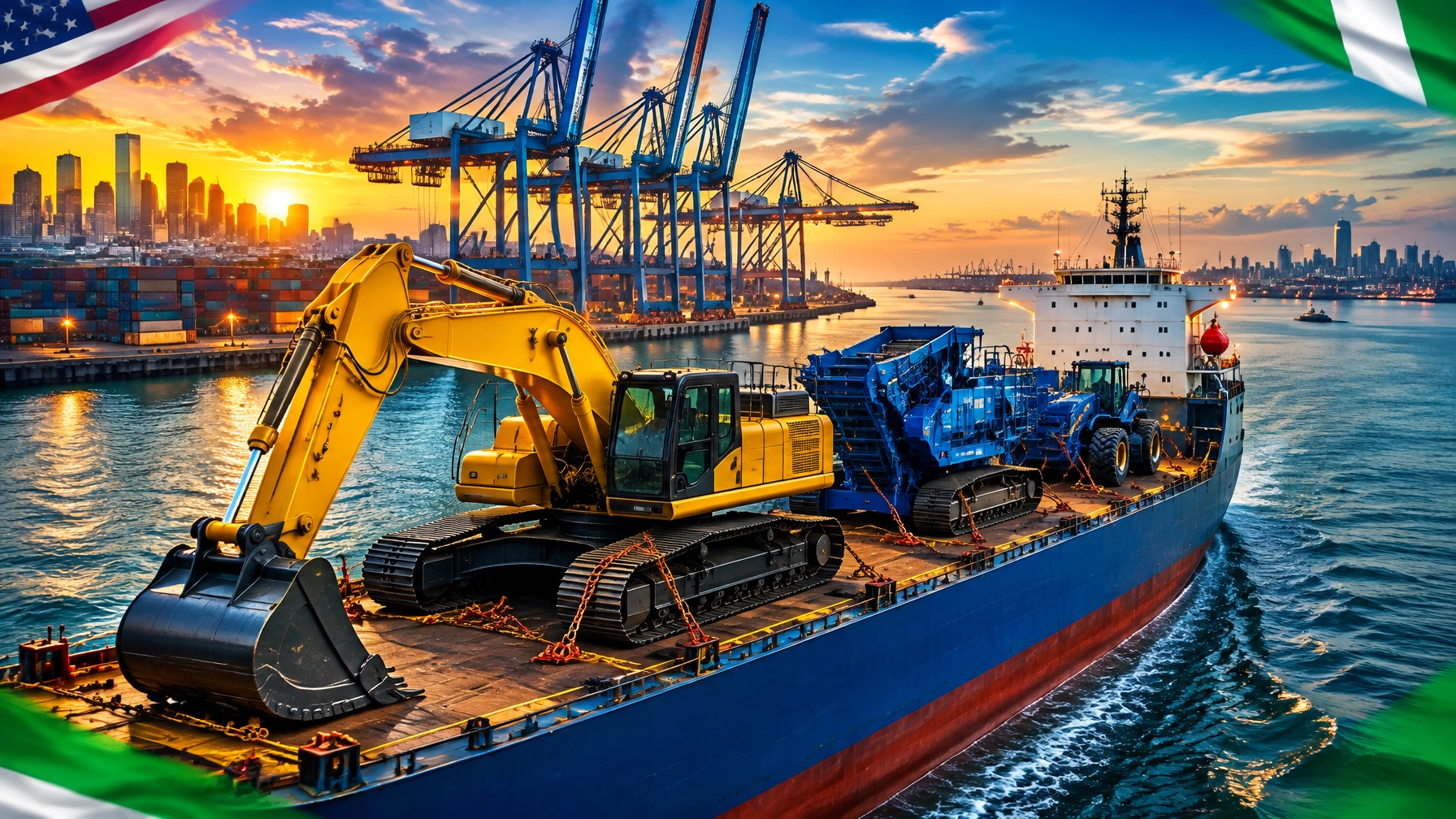
Shipping heavy machinery from Houston to Nigeria requires more than booking the first available vessel. The right international seaport must match the machine’s weight, dimensions, loading method, destination city, draft requirements, lifting capacity, customs process, and inland delivery route.
For most Houston-to-Nigeria shipments, Tin Can Island and Apapa remain practical for RoRo and containerized machinery bound for Lagos and southwest Nigeria. Lekki Deep Sea Port offers deeper water and modern container infrastructure, while Onne Port is the strongest choice for very-heavy project cargo and equipment destined for Port Harcourt or the Niger Delta.
PSI Global Logistics coordinates the full movement: from Houston pickup and export documentation to Nigerian customs clearance, live tracking, heavy haulage, and final door delivery.
What is the best international seaport for heavy machinery from Houston to Nigeria?
For most Houston-to-Nigeria machinery shipments, Tin Can or Apapa is practical for RoRo and regular container freight bound for Lagos and southwest Nigeria. Lekki is stronger for containerized cargo requiring deeper water and modern ship-to-shore equipment. Onne stands out for 200–300-ton project lifts or delivery to Port Harcourt and the Niger Delta.
The best choice depends on four operational facts:
- Is the machine self-propelled?
- Does it fit inside a container or on a flat rack?
- What is its gross weight and center of gravity?
- Where is the final Nigerian delivery site?
Houston provides a strong origin gateway for project cargo, with access to heavy-haul trucking, breakbulk facilities, RoRo services, container lines, and specialized loading teams. PSI also provides reliable pickup coordination from Houston locations and manages the export workflow before cargo reaches the terminal.

Which shipping method is best for heavy machinery?
Choose RoRo for drivable equipment, flat rack or open-top containers for oversize machinery that can be lifted, standard containers for compact units, and breakbulk for extremely large or heavy equipment that cannot safely fit within container limits.
RoRo: best for self-propelled machinery
Roll-on/Roll-off shipping is often suitable for:
- Excavators
- Bulldozers
- Loaders
- Tractors
- Trucks
- Buses
- Graders and pavers
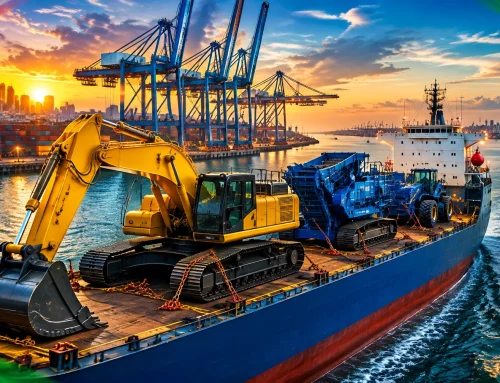
The machinery is driven or towed onto the vessel, reducing crane lifts and handling points. That can lower damage risk and simplify loading. The machine must typically be operational, free of fluid leaks, clean of soil and organic debris, and prepared with working brakes and steering systems.
Flat rack and open-top containers: best for oversize units
Flat racks are useful when equipment exceeds standard container height or width but remains suitable for container-vessel transport. They support machinery such as:
- Industrial generators
- Compressors
- Boilers
- Pumps
- Construction attachments
- Disassembled production-line components
Professional lashing is essential. The securing plan must account for weight distribution, axle loads, center of gravity, tie-down points, and ocean movement.
Standard containers: best for smaller machinery
A 20-foot or 40-foot container may be the most economical option when the equipment fits safely after partial disassembly. Containerization offers strong protection, regular sailing schedules, and simpler terminal handling.
Breakbulk: best for project cargo
Breakbulk is appropriate for machinery that is too heavy, tall, wide, or irregular for a flat rack or RoRo deck. It may involve direct loading into a vessel’s hold using ship gear, shore cranes, or tandem lifting arrangements.
For all four options, PSI reviews exact dimensions, weight, lifting points, loading photographs, and destination requirements before recommending a route.
How do Apapa, Tin Can, Lekki, and Onne compare?
Port selection is a balance between cargo handling, draft, equipment, congestion, inland distance, and vessel availability. No single Nigerian gateway wins for every machine. Lagos-area ports generally support southwest deliveries, Lekki offers modern deep-water container infrastructure, and Onne provides the clearest advantage for ultra-heavy project cargo.
| Nigerian seaport | Indicative draft and infrastructure | Machinery handling strengths | Best use case | Main consideration |
|---|---|---|---|---|
| Apapa | Main container facilities are commonly reported at approximately 12.5 m maximum draught, with other berths and channels varying by location and maintenance condition. | Containers, general cargo, RoRo, and project equipment handled through mobile harbor cranes and terminal equipment. | Machinery for Lagos, Ogun, Ibadan, and southwest Nigeria. | Congestion, road access, and ongoing quay rehabilitation require close planning. |
| Tin Can Island | Berth depths commonly range from approximately 7 m to 11.5 m, depending on berth and operating conditions. | Strong option for containers, vehicles, RoRo, and general heavy equipment. Public terminal information identifies mobile cranes, RTGs, reach stackers, and yard equipment. | Regular Houston-to-Lagos container or RoRo shipments. | Draft margins and terminal conditions must be checked against vessel and cargo requirements. |
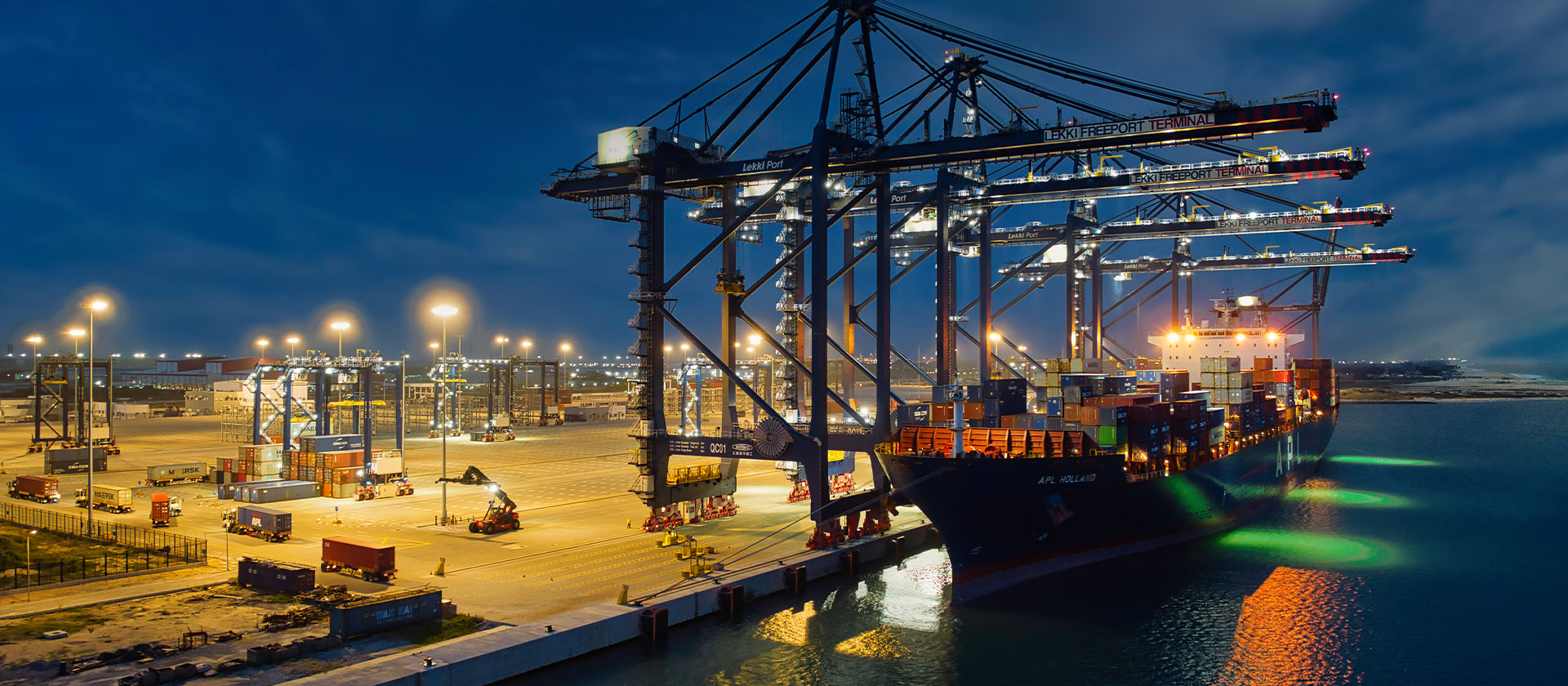
| Lekki Deep Sea Port | Official port information identifies approximately 16 m draught, five 65-ton ship-to-shore cranes, and 15 RTG cranes. | Modern container handling, deeper access, large vessels, and containerized industrial machinery. | Flat racks, open tops, and containerized machinery when the carrier confirms a Lekki call or transshipment. | Inland delivery may be longer for destinations outside the Lagos Free Zone and southwest corridor. |
| Onne Port | Terminal conditions vary, but deep-water facilities are reported at approximately 12 m alongside and 15 m in the approach channel. | Documented heavy-lift capability includes a Liebherr mobile harbor crane rated at approximately 208 tons and tandem Grove cranes capable of lifting up to approximately 300 tons for a single heavy cargo. | Ultra-heavy machinery, oil and gas equipment, and projects in Port Harcourt or the Niger Delta. | Confirm the exact terminal, berth, vessel access, permits, and inland route before booking. |
Published port figures are indicative rather than a substitute for a current terminal confirmation. Dredging, berth rehabilitation, tide, vessel trim, and operating restrictions can change the effective draft available for a particular sailing.
For current facility information, review the official Lekki Deep Sea Port website and the Nigerian Ports Authority’s Onne information.
How do draft depth and crane capacity affect the port choice?
Draft determines whether the vessel can safely enter and berth with its planned cargo load, while crane capacity determines whether the machinery can be lifted without specialized vessel gear. A deep port is not automatically the best port if the terminal lacks suitable project-cargo handling or the inland route cannot support the load.
Use this checklist before selecting a gateway:
- Confirm the machine’s gross weight. Include fuel, attachments, skids, packaging, and lifting frames.
- Confirm total dimensions. Measure length, width, height, and any removable components.
- Identify the lifting method. Determine whether the cargo is driven aboard, crane-lifted, or loaded with vessel gear.
- Check the crane’s working capacity. A crane’s headline rating may change with radius, boom configuration, tandem lifts, and lifting height.
- Review the berth and vessel limits. Confirm draft, maximum vessel length, berth availability, and terminal restrictions.
- Inspect the inland route. Bridges, road width, turning radius, overhead lines, weak roads, and security requirements can determine whether a port is viable.
Lekki’s five 65-ton STS cranes are designed primarily for container operations. They should not be treated as a 65-ton universal project-cargo lift at every radius. Onne’s published 208- to 300-ton heavy-lift figures make it more compelling for exceptionally heavy machinery, subject to a terminal engineering review.
Which Nigerian import documents are required for heavy machinery?
Heavy-machinery imports require early coordination of commercial, customs, banking, standards, and origin documentation. The core Nigerian documentation package commonly includes Form M, PAAR, SONCAP documentation where applicable, and CCVO, supported by accurate invoices, packing lists, HS codes, and the bill of lading.
Form M
Form M records the importer’s intent to import and supports the banking and customs process. It should be prepared before shipment, using consistent product descriptions, values, quantities, origin information, and HS classification.
PAAR
The Pre-Arrival Assessment Report supports customs valuation and assessment. Inaccurate descriptions, inconsistent values, or missing supporting documents can create avoidable holds and disputes.
SONCAP
SONCAP applicability depends on the product, HS code, and Nigerian regulatory requirements. Industrial machinery should be reviewed individually rather than assumed to be exempt or automatically regulated.
CCVO
The Combined Certificate of Value and Origin confirms declared value and origin details. It must match the commercial invoice, packing list, Form M, and other shipment records.
PSI’s shipping documentation guidance explains why document mismatches cause clearance delays. Our workflow checks descriptions, weights, dimensions, values, and shipment references before cargo moves.
How does inland delivery affect the seaport decision?
The nearest seaport is not always the lowest-cost option. A port that saves one ocean day may create extra inland mileage, route restrictions, escort requirements, or equipment-transfer costs. The final delivery address, road survey, low-bed availability, and customs release process must be evaluated together with the ocean route.
Lagos and southwest Nigeria
Apapa, Tin Can, and Lekki are generally practical for machinery delivered to:
- Lagos
- Lekki
- Ikeja
- Ogun State
- Ibadan
- Oyo State
- Other southwest locations
Apapa and Tin Can may offer established carrier and clearing-agent familiarity. Lekki may provide an infrastructure advantage for containerized cargo, but the final haulage route should be costed before booking.
Port Harcourt and the Niger Delta
Onne is often the stronger choice for machinery destined for:
- Port Harcourt
- Rivers State
- Bayelsa
- Delta
- Akwa Ibom
- Oil and gas bases
- Remote industrial or energy projects
PSI arranges coordinated door-to-door delivery, including specialized trailers, route planning, port release, and final-site delivery. Our door-to-door Nigeria logistics service keeps the shipment under one managed workflow instead of splitting responsibility between unknown providers.
How does PSI Global Logistics move heavy machinery safely?
PSI combines Houston pickup, mode selection, documentation control, port coordination, cargo securement, Nigerian customs support, live tracking, and inland delivery into one managed process. That integrated workflow helps businesses move equipment on schedule and in excellent condition without managing every carrier, terminal, and document separately.
Our process includes:
- Cargo assessment: We review dimensions, weight, condition, lifting points, destination, and delivery deadline.
- Mode and port planning: We compare RoRo, container, flat rack, breakbulk, and the most suitable Nigerian gateway.
- Houston pickup: We coordinate reliable pickup and heavy-haul movement to the export terminal.
- Secure loading: Machinery is lashed according to its center of gravity and transport requirements.
- Documentation control: Our team coordinates the commercial and regulatory documents required for export and Nigerian clearance.
- Live visibility: PSI’s instant live tracking system provides shipment updates across ocean, port, and inland stages.
- Final delivery: We arrange Nigerian heavy haulage from the port to the project site.
For eligible air freight shipments, PSI also offers complimentary Houston air cargo pickup. Heavy machinery usually moves by ocean, but our broader freight capability supports urgent parts, controls, documents, and replacement components when a project cannot wait.
Contact PSI Global Logistics at 713-589-2925 for a machinery review and route recommendation. Share the equipment’s dimensions, weight, operating condition, Houston pickup location, and Nigerian delivery address so our team can match the cargo with the right port, handling method, and inland plan.
Frequently Asked Questions About Heavy Machinery Seaports
The answers below summarize the practical decisions involved in routing heavy machinery from Houston to Nigeria. Final recommendations depend on current vessel schedules, terminal acceptance, cargo dimensions, customs requirements, destination access, and the lifting plan confirmed for the specific shipment.
Is Onne better than Apapa for heavy machinery?
Onne is generally better for exceptionally heavy project cargo because its facilities include documented lifting capability in the approximate 208- to 300-ton range. Apapa is often more practical for machinery bound for Lagos and southwest Nigeria, especially when the cargo moves by RoRo or standard container service.
Is Lekki Deep Sea Port suitable for heavy machinery?
Yes, Lekki can suit containerized heavy machinery, flat racks, and open-top cargo when the carrier confirms a call or transshipment. Its reported 16-meter draught and modern ship-to-shore equipment provide a strong infrastructure advantage, but heavy-lift capability must be confirmed for machinery that exceeds normal container-handling limits.
Should a self-propelled excavator move by RoRo?
RoRo is often the simplest option for a self-propelled excavator because the machine can be driven or towed aboard, reducing crane lifts. The excavator must meet the carrier’s operational requirements, including working brakes, safe steering, acceptable dimensions, clean condition, and no active fluid leaks.
What documents are needed to clear machinery in Nigeria?
The typical documentation package includes Form M, PAAR, CCVO, commercial invoice, packing list, bill of lading, accurate HS classification, and SONCAP documentation where applicable. Requirements can vary by machine type and HS code, so the importer should confirm compliance before shipment.
How long does Houston-to-Nigeria heavy machinery shipping take?
Ocean transit may take approximately 17–30 days depending on the service and routing. A realistic door-to-door planning window is often five to seven weeks after allowing for Houston pickup, loading, documentation, ocean transit, Nigerian clearance, and inland delivery.
Can PSI deliver machinery beyond the Nigerian port?
Yes. PSI coordinates door-to-door delivery beyond Apapa, Tin Can, Lekki, and Onne using suitable heavy-haul equipment and local delivery partners. Route planning may include low-bed trailers, permits, escorts, bridge checks, and site-access coordination for oversized or high-value machinery.




Leave A Comment